




Throughout my mid-thirties and up until my early forties, I had tried various diets in a bid to reverse my ever-expanding waistline and weight gain. I tried low-carb and the Zone diet. Although they both provided some initial fat loss, I couldn’t sustain them as part of my lifestyle as they were inconvenient and placed too many restrictions on what I could eat. Once my initial enthusiasm waned over a period of months and my eating patterns reverted back to what felt natural, my weight and my waistline measurement would creep upward once more.
Although I’m not one of those who feel hungry enough in the mornings to eat a hearty breakfast, I also tried forcing myself to eat breakfast in addition to another 5 or so small meals throughout my waking hours in a vain attempt to keep my blood sugar levels constant as I was led to believe this was a good way to eat. This did nothing to help my waistline and little did I know that this pattern of eating would actually have the effect of causing an insulin spike after every time I ate which would then have a knock-on effect of lowering my blood sugar levels back down again. This was a natural consequence of a natural biomechanical process evolved over many millennia.
Diet; Habitually Consumed Food or Temporary Change To Habitually Consumed Food
Let me clarify what I mean by “diet” because the word might either conjure up visions of short-term change in how one eats or you might think of it as simply how you describe what a person eats e.g. Eskimos have a diet of predominantly animal meat. Both definitions are valid, it just depends on the context, but let me be clear that short-term diets can only provide short-term results. If we change our diets in the short-term and achieve weight loss, it doesn’t take a genius to appreciate that going back to the old pattern of eating will result in us reverting back to our previous condition.
What I was looking for was a diet which I could apply over the long-term so that I could get long-term benefits. It had to be something which I could apply with very little effort and it had to allow me to eat the foods I enjoyed. Ultimately, I wanted a diet which would help me achieve my fat loss goals and which I could sustain over the long-term. In order to be sustainable, it had to get out of the way of my desired lifestyle.
I’m pleased to say that I found that diet and as of April 2019, I’ve sustained it for 17 months. For me, the most successful diet is one that brings my food consumption into a specific time window. This is known as time-restricted eating or intermittent fasting.
Some people will visibly recoil when they hear the word “fasting”, but the reality is that most people already do intermittent fasting when they go to sleep every night. Also, for as long as our species has existed (300,000 years or so), we have intermittently fasted. Our bodies have evolved to function optimally in a food-scarce environment and it’s only been in the last few hundreds of years that we’ve had such ready access to food.
Our bodies haven’t yet evolved to be able to cope with the constant influx of refined foods so it’s no wonder why we’re seeing significant increases in dietary conditions such as type 2 diabetes¹. At age 41, I was diagnosed as prediabetic with elevated cholesterol. Today, at 44, after over a year of living an intermittent fasting lifestyle both my blood sugar and cholesterol levels are in the healthy range. Not only that, but I’ve lost over 5 inches from around my waist and I’m in the best shape of my life.
Liberation From Dieting
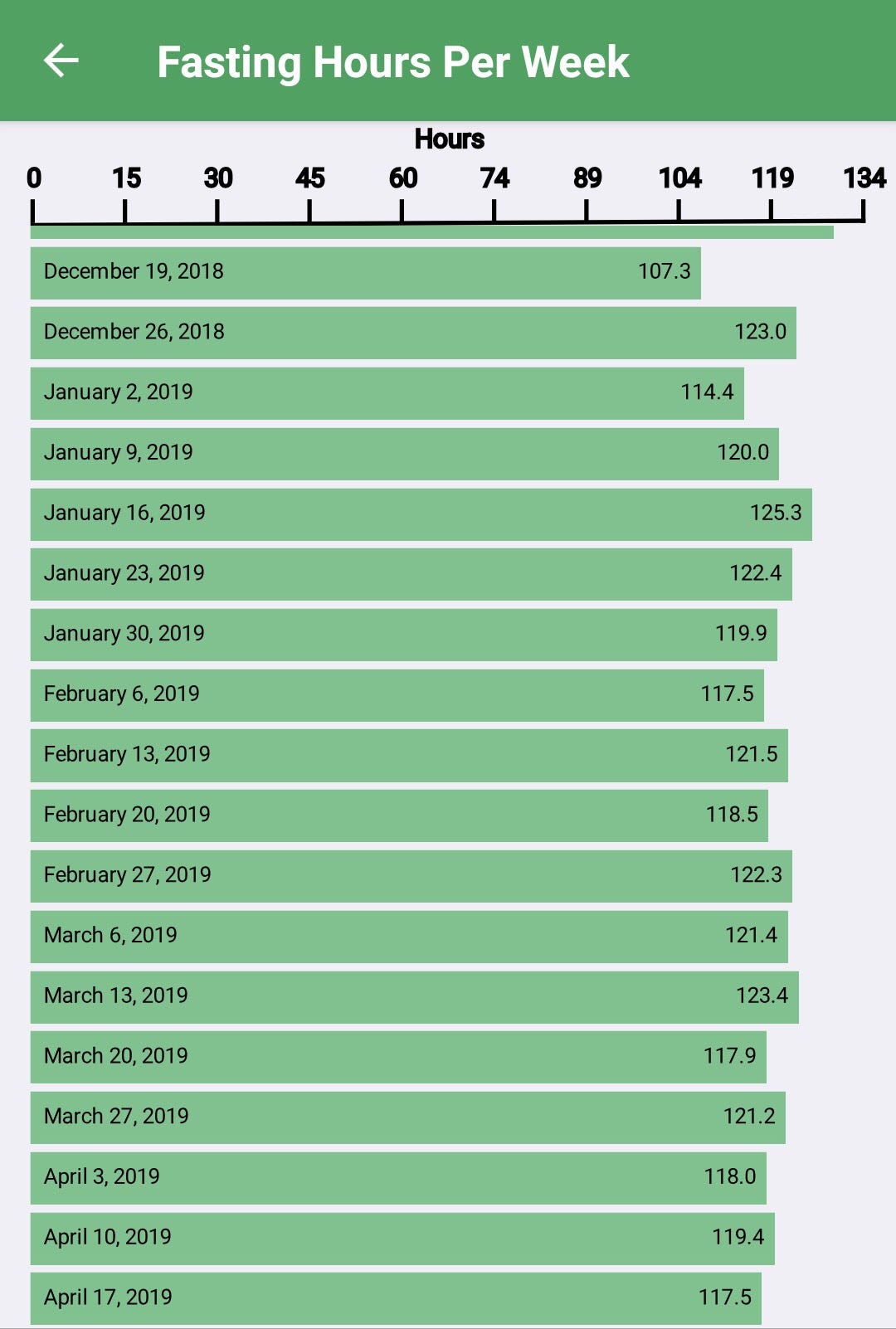
No longer do I need to track calories or my macros. Nutrition is still important, but I can eat the foods I enjoy without any guilt and without the hunger I used to feel. I aim to do a daily fast of at least 16 hours which in real world terms means not snacking after dinner and skipping breakfast. Sometimes I fall short of 16 hours and sometimes I go over, but that’s okay because my weekly fasting hours will average around the 112-hour mark (7 days x 16 hours = 112 hours of fasting per week). Occasionally, I’ll fall wildly short because of a social event, but that’s okay because I know occasional blips don’t have a significant impact from a long-term perspective. In fact, they’re important for helping me stay the course!
Here’s a screen capture from Vora; the app I use to track my daily fasts. This screen shows my weekly hours of fasting since December 2018 until April 2019.
Intermittent Fasting Isn’t Just Calorie Restriction
There are some who will point out that intermittent fasting just provides a means to achieve a caloric deficit and that there are no other benefits besides i.e. when we expend more energy than we consume. Whilst intermittent fasting can help with maintaining a caloric deficit through appetite correction and the regulation of hormones associated with hunger², it’s not the be-all and end-all when you consider the difference between simply reducing the amount of calories you consume versus time restriction. There are multiple other benefits that come with reducing the number of insulin spikes our bodies experience. An increased potential for releasing stored body fat as a fuel source is just one of those unavailable if you’re eating every few hours as elevated insulin levels within the body is a blocker for lipolysis which is the breakdown of fats for energy.
Calories in versus calories out as a weight-loss paradigm is, in my opinion, an oversimplification around how the body stores and uses food energy. Just as a pound of feathers and a pound of lead would have a different effect on your foot if dropped from a height, the body treats different types of calories differently depending on what they are and when they’re consumed. This is not only my personal experience, but of many others too. Dr. Jason Fung is one of the leaders in using fasting as a means of treating modern day dietary diseases and it’s one of his books (The Complete Guide to Fasting) which helped get me started on my intermittent fasting lifestyle. I would encourage you to seek out his writings or videos to learn more about the science behind fasting.
Intermittent fasting has helped me achieve my health goals, required zero investment of time or money and I’ve been able to go about my life whilst doing it. Intermittent fasting is by far my most successful diet to date.
[1]: Diabetes UK (27th February 2019). Number of people with diabetes reaches 4.7 million
https://www.diabetes.org.uk/about_us/news/new-stats-people-living-with-diabetes
[2]: Natalucci G, Riedl S, Gleiss A, Zidek T, Frisch H. Spontaneous 24-h ghrelin secretion pattern in fasting subjects: maintenance of a meal-related pattern.
Eur J Endocrinol. 2005 Jun;152(6):845-50. PubMed PMID: 15941923.
https://www.ncbi.nlm.nih.gov/pubmed/15941923?report=abstract